
 In your quote
In compare
Electric Hoists or Jib Hoists and Accessories
52 products · Cranes, Hoists and Lifting Equipment
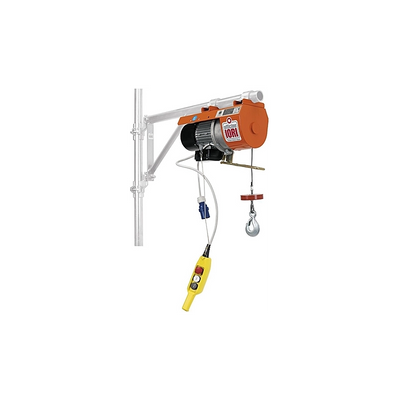
Electric jib hoists and wall-mounted hoists are used to lift loads on building sites, in workshops and during maintenance work: the motor with rope and hook is mounted on a cantilever arm, the jib, which is fixed to scaffolding, a post or a wall. This collection also includes the supports and accessories for installing and using them.
Types in the collection
- Jib hoists by Iori Officine, Imer Group and Unimec, and European-type electric hoists.
- Electric trolley hoists with jib mounting, for fitting a hoist on the arm.
- Supports and jibs with clamps, also for Fervi hoists.
- Tripod hoists and accessories such as bucket holders.
How to choose
What matters is the maximum capacity, the lifting height, the available electrical supply and the projection of the arm from the fixing point. The support must be suitable for the post or wall it is mounted on, and the equipment must be used within its rated capacity and in accordance with the manufacturer's instructions.
Models and power ratings
There are jib models to be fixed to the structure, trestle-mounted models and tripod models with a mini crane, as well as winches. Where the product sheet states the power, motors range from 0.3 to 6 kW; the most common value is 2.2 kW. Accessories also include twin rails.
See also: Pulley blocks and hoists and Iori Officine.
AMES works on a quotation basis: tell us the use, the working conditions and the quantities and we will propose the most suitable models, with availability and delivery times.
Active filters:
Products in this collection
In your quote
In compare
 In your quote
In compare
 In your quote
In compare
 In your quote
In compare
 In your quote
In compare
 In your quote
In compare
 In your quote
In compare
 In your quote
In compare
 In your quote
In compare
 In your quote
In compare
 In your quote
In compare
 In your quote
In compare
 In your quote
In compare
 In your quote
In compare
 In your quote
In compare
 In your quote
In compare
 In your quote
In compare
 In your quote
In compare
 In your quote
In compare
 In your quote
In compare
 In your quote
In compare
 In your quote
In compare
 In your quote
In compare
 In your quote
In compare
Frequently asked questions: Electric Hoists or Jib Hoists and Accessories
What is a jib hoist and how does it work?
A jib hoist is a device in which the motor with rope and hook is mounted on a cantilever arm, called the jib, which is fixed to scaffolding, a post or a wall. It is used to lift loads on sites, in workshops and during maintenance work where there is no crane. The arm must remain fixed to a structure suited to the declared capacity. Always check the capacity on the plate.
Jib hoist or trestle hoist: which to choose?
A jib hoist is fixed to a structure, such as a wall or scaffolding, and takes up little floor space. A trestle or tripod hoist is self-standing: it is placed on the ground and needs no fixing point. Choose according to the available structure and the work area. The catalogue includes both, for example the DT 800D trestle-type and the DT 200I jib-type from Iori Officine.
Which brackets are needed to fix the jib?
The jib is fixed with clamps or a wall bracket, depending on the available point. The catalogue includes jibs for electric hoists, jibs with clamps and the AWSK wall-mounted jib crane from Probst. Before fitting, check that the fixing point, such as the post, scaffolding or wall, can bear the maximum expected load with the cantilever arm. Tighten the clamps well before every lift.
Indoor, window and outdoor props: what are they used for?
The Iori Officine props, models A, C and D, are used to support the hoist arm against a wall or opening: model A for indoor use, C for windows and D for outdoor use. The purpose is to lock the arm stably against the structure. Choose the prop based on the bearing point and the size of the opening. Check that the prop is correctly fixed before lifting.
European-type electric hoist: when is it used?
A European-type electric hoist is a lifting device mounted on a structure or a jib, used to lift loads in workshops or during maintenance. The catalogue also includes single-phase electric hoists with jib connection from Unimec. The choice between single-phase and three-phase depends on the available electrical supply. Check capacity and lifting speed on the data sheet.
Tripod or trestle hoists: what loads can they lift?
The Gruetta GT 350, GT 500 and GM 500 tripod hoists from Iori Officine and the DS 500, DS 1000 and DM 800MAX trestle-type hoists are designed to lift materials and equipment. The maximum load varies greatly from model to model, so read it on the plate. Do not lift people unless the manufacturer allows it. Check the ground support and stability before starting.
Bucket holders and skip holders: what are they used for on the hoist?
Bucket holders, with 2, 3 or 4 positions, from Iori Officine and Tekcnoplast are used to hold mortar or material buckets during work, connected to the hoist arm. The Iori Officine skip holder is a support to be fixed to the hoist to hold the skip indicated on the data sheet. Check the maximum permitted weight and do not hang anything beyond the limit. The load must be distributed evenly.