
 In your quote
In compare
Piston Compressors
457 products · Compressors
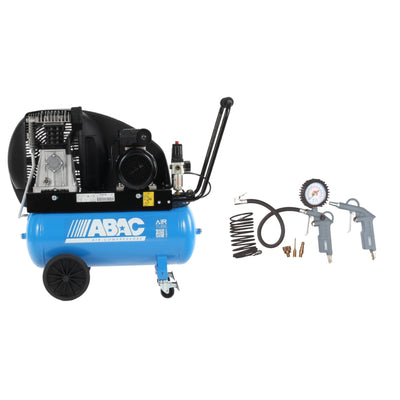
Piston compressors produce compressed air using one or more pistons that compress the air into a receiver. They are the most widely used compressors on site, in workshops and in small businesses, for powering air tools, spray guns, tyre inflation and air systems. The collection includes machines from Abac, Fini Compressori and other manufacturers.
Types available
- Direct-drive compressors, compact, suitable for occasional use.
- Belt-driven compressors, sturdier, for continuous professional use.
- Single-stage and two-stage: the two-stage reaches higher pressures.
- Silenced and oil-free, for environments where noise matters.
- Industrial versions with a large receiver and three-phase motor.
How to choose
Look at the air the tools need (flow rate) and the working pressure, then at the receiver capacity and motor power. Consider the electrical supply available, single-phase or three-phase, the noise and the mobility: wheels and a handle for site use, fixed versions for the workshop. An adequate flow rate prevents the compressor from always working at its limit.
For models and availability, request a quote from AMES Srl.
Active filters:
Products in this collection
In your quote
In compare
 In your quote
In compare
 In your quote
In compare
 In your quote
In compare
 In your quote
In compare
 In your quote
In compare
 In your quote
In compare
 In your quote
In compare
 In your quote
In compare
 In your quote
In compare
 In your quote
In compare
 In your quote
In compare
 In your quote
In compare
 In your quote
In compare
 In your quote
In compare
 In your quote
In compare
 In your quote
In compare
 In your quote
In compare
 In your quote
In compare
 In your quote
In compare
 In your quote
In compare
 In your quote
In compare
 In your quote
In compare
 In your quote
In compare
Frequently asked questions: Piston Compressors
What is a piston compressor used for?
The piston compressor compresses air into a tank to power pneumatic tools, spray guns, inflation and small installations. It is the most widespread type on building sites, in workshops and in small businesses. For intermittent use, with one or two tools at a time, it is often the most practical choice.
What tank capacity should I choose?
The tank capacity, in litres, determines how much air builds up before the motor restarts. The catalogue ranges from the 2 litres of models for occasional use up to the 500 and 900 litres of compressors for continuous use. Choose according to how often you use it and the tools you will run.
Single-stage or two-stage: which should I choose?
The single-stage compresses air in a single pass and suits most uses with common tools. The two-stage compresses in two passes and reaches higher pressures, useful for tools that need more force. Check the pressure the tool requires before choosing.
Direct-drive or belt-driven compressor: what is the difference?
The direct-drive (coaxial) type has the motor and pump aligned on the same axis, is compact and intended for occasional use. The belt-driven compressor uses a transmission that separates motor and pump, and is sturdier for continuous professional use. The choice depends on how often you work and the space available.
When do I need a silenced or oil-free compressor?
Silenced models are designed for places where noise matters, such as workshops or premises close to residential areas. Oil-free models do not need pump lubrication, so the air comes out cleaner, which is useful in small workshops or for delicate work. Check the noise level and the type of lubrication on the product page.
How do I use a piston compressor safely?
Release the pressure from the tank before disconnecting hoses or fittings, and do not exceed the maximum pressure shown on the data plate. Use hoses and fittings suited to the working pressure and check them for cracking. Drain the condensate from the tank regularly, because rust weakens its walls.
When is a petrol-driven compressor worth it?
The petrol-driven compressor has an internal combustion engine and does not need a power socket, so it is used on outdoor sites or where there is no mains power. It must be used in ventilated spaces, because the exhaust gases are harmful, and refuelled with the engine off. In the EngineAir models in the collection the maximum pressure is 10 bar, shown in the product name.