
 In your quote
In compare
Builder's Spirit Levels
58 products
This collection brings together the levelling instruments used in building to check horizontality, verticality and slope in masonry, screeds, windows and doors, and structures. Alongside aluminium spirit levels there are digital instruments and measuring accessories.
Types in the collection
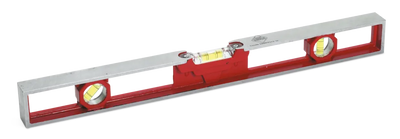
- Graduated levels in extruded aluminium, some with a magnetic base;
- compact magnetic levels and digital inclinometers;
- water levels;
- circular vials for checking surfaces;
- sets of levels and rods.
The brands included are Metrica, Stanley and A.M.E.S. products.
How to choose
The long aluminium level is used for walls and alignments, the short magnetic one for pipes and profiles. The digital inclinometer is for when you need to read an angle or a slope in degrees or percent, while the water level is for transferring heights between distant points without a direct line of sight.
On site a single instrument is rarely enough: a long level for walls, a compact one for services and an inclinometer for slopes cover most checks.
For models and quantities, request a quote from AMES Srl.
Active filters:
Products in this collection
In your quote
In compare
 In your quote
In compare
 In your quote
In compare
 In your quote
In compare
 In your quote
In compare
 In your quote
In compare
 In your quote
In compare
 In your quote
In compare
 In your quote
In compare
 In your quote
In compare
 In your quote
In compare
 In your quote
In compare
 In your quote
In compare
 In your quote
In compare
 In your quote
In compare
 In your quote
In compare
 In your quote
In compare
 In your quote
In compare
 In your quote
In compare
 In your quote
In compare
 In your quote
In compare
 In your quote
In compare
 In your quote
In compare
 In your quote
In compare
Frequently asked questions: Builder's Spirit Levels
Which spirit level should I choose to check that masonry and screeds are level?
For masonry and screeds you need a long aluminium spirit level, which covers more points of contact and gives a more stable reading. Spirit levels with a magnetic base stay firmly on metal surfaces, while water levels check the plane over longer distances. In the catalogue you will find aluminium spirit levels, such as the AZB and BIG X models. Choose the length according to the width of the piece.
How do I use a water level to transfer heights between two points?
The water level uses a tube filled with water: the level of the liquid at the two ends stays at the same height, even at a distance. It is used to transfer a height from one point to another, for example between different walls. Fill the tube without air bubbles, rest the ends at the points to be compared and mark the level. In the catalogue you will find water levels such as the S 1012 G.
Magnetic spirit level or post level: when should I use it?
The magnetic spirit level attaches to metal surfaces and leaves your hands free, which is useful on profiles, pipes and metalwork. The post level, such as the magnetic Stanley 0-47-720 in the catalogue, is used to check the plumb of a post or an upright. Rest it against the piece and read the bubble without moving it. To check a flat surface, use a long spirit level instead.
Which digital level or inclinometer should I use to measure slopes?
The digital level shows the slope on a display, with a direct reading that reduces the error of reading the bubble. In the catalogue you will find digital models from Sola, such as the RED 60. Use it to check the slopes of drains, inclined planes and window and door frames. Check the reading against a reference surface before using it, and calibrate it according to the manual.
What is a circular vial for flat surfaces and what is it used for?
The circular vial is a small round level with a bubble in the centre, which shows when the surface is level in both directions. It rests on narrow surfaces where a long spirit level will not fit. In the catalogue you will find the Stanley circular vial for flat surfaces. For a reliable check, rest it at several points and rotate it to verify the reading.
How do I choose a level for installations or for reference lines?
For installations, compact levels or ones with several vials are used, to be rested on pipes and ducts. To stretch a reference line over long distances, such as for a wall or a floor, a line level is used. In the catalogue you will find the JP installation level and the UZ 8 line level. Choose the model according to the length and the surface to be checked.
How do I check that a spirit level is still accurate?
Rest the level on a straight surface and mark the position of the bubble, then turn it round by 180 degrees and compare the reading: if the bubble shifts, the level needs to be recalibrated or replaced. Keep levels and vials away from knocks and temperature swings, which can alter the bubble. For digital models consult the manual for calibration. For checking reference surfaces there are precision linear cast iron levels, such as the Metrica prismatic base.