
 In your quote
In compare
Castors and Wheels for Trolleys
73 products · Manual Handling and Transport
Wheels and supports for trolleys, wheelbarrows, pallet trucks and handling equipment: workshops, warehouses, building sites and maintenance. The collection includes A.M.E.S., Svelt, Vigor, Unifix, Verdelook, Carver, Fervi and Pramac items.
They are used both to build or fix a trolley and to replace worn wheels on equipment already in use, from wheelbarrows to pallet trucks. The range includes models for light loads and for heavier use, and you can also find specific spare parts for certain pallet truck brands.
What you will find in this collection
- Twin and solid wheels, also with swivel stem or fork mount
- Steering wheels for pallet trucks
- Castors for buckets and small trolleys
- Swivel and fixed wheels, with plate or stem mounting
How to choose
- State the wheel diameter and the load capacity per wheel according to the load.
- Choose the type of fixing (plate or stem) to match the existing mounting.
- Consider the floor the wheel will run on: smooth, uneven or outdoors.
For a tailor-made quotation, write to the AMES technicians: we will help you find the right items for your job.
Active filters:
Products in this collection
In your quote
In compare
 In your quote
In compare
 In your quote
In compare
 In your quote
In compare
 In your quote
In compare
 In your quote
In compare
 In your quote
In compare
 In your quote
In compare
Unifix
Swivel castor with brake and threaded stud Unifix
Code unifix-con-perno-filettato-rotante-360-e-fermo
 In your quote
In compare
 In your quote
In compare
 In your quote
In compare
 In your quote
In compare
 In your quote
In compare
 In your quote
In compare
 In your quote
In compare
 In your quote
In compare
 In your quote
In compare
 In your quote
In compare
 In your quote
In compare
 In your quote
In compare
 In your quote
In compare
Svelt
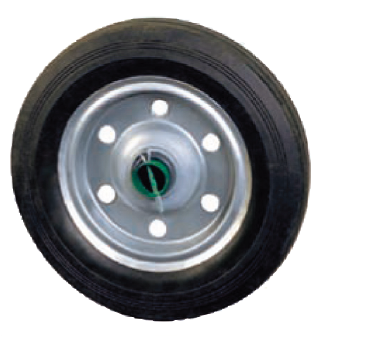
Puncture-proof solid wheel for trolley, 150 kg capacity, Svelt
Code ruota-per-carrello-piena-antiforatura
 In your quote
In compare
Svelt
Puncture-proof solid wheel for trolley, 120 kg capacity, Svelt
Code ruota-per-carrello-piena-antiforatura-mozzo-plasti
 In your quote
In compare
 In your quote
In compare
Frequently asked questions: Castors and Wheels for Trolleys
How do I choose a wheel for a trolley?
The wheel is chosen according to the load to be supported, the type of floor and the working environment. Solid or polyamide wheels are suited to transport on smooth surfaces, pneumatic ones to uneven ground. Diameter also matters: larger wheels cope better with obstacles and rough ground, but need more space under the trolley.
What is the difference between a fixed-plate and a swivel-plate wheel?
A fixed-plate wheel always rolls in the same direction and is suited to long straight runs. The swivel plate lets the wheel rotate on itself, to manoeuvre the trolley in tight spaces. Fixed and swivel wheels are often combined, and the brake locks the wheel when the trolley is stationary.
How do I replace a wheel on a trolley or a wheelbarrow?
Before replacing a wheel, measure the diameter, the type of stem and the hole spacing of the fixing plate. The threaded stem screws into the support, while the plate is fixed with screws or studs. Check that the new wheel has a load capacity equal to or greater than the old one, and change the inner tube when the pneumatic wheel loses pressure.
What load capacity should a trolley wheel have?
The load capacity is the maximum load that a single wheel can bear, declared by the manufacturer for each model. The total load of the trolley is spread across all the wheels, so it is best to consider the maximum expected weight and not the average. A load above the capacity wears out the bearing and can cause the support to fail.
Are compressor wheels and wheelbarrow wheels interchangeable?
Not always. Compressor wheels and wheelbarrow wheels have different diameters, bores and load capacities, so they must be chosen according to the model of the equipment. A spare wheel with stem and plate is compatible only if the dimensions and the fitting match. Before buying, compare the measurements with those of the wheel to be replaced.
How do I use a trolley with wheels safely?
Do not load the trolley beyond the stated capacity and distribute the weight low down, with the heaviest loads close to the wheel axle. Going downhill, it is best to push the trolley in front of you rather than pull it, and lock the brakes when it is stationary. Check the wheels and stems regularly, because a worn wheel can make the trolley swerve suddenly.
Are polyamide wheels suitable for outdoor use?
Polyamide wheels are strong and perform well on smooth indoor floors, such as those in warehouses and workshops. On dirty or wet ground, or with gravel, a solid or pneumatic wheel with a suitable tread is better. The material should also be chosen according to contact with oil and chemicals, checking the manufacturer's data sheet.