
 In your quote
In compare
Squares
69 products · Analogue Measurement and Marking-Out
The square is the tool used to mark out and check right angles and to transfer measurements accurately. It is used on site, in carpentry, in joinery and in masonry, whenever an angle must be corrected before cutting, laying or fixing.
Types in the collection
- Try squares, with a stock, for marking out and checking squareness.
- Joiner's and carpenter's squares, in steel, aluminium or with a graduated blade.
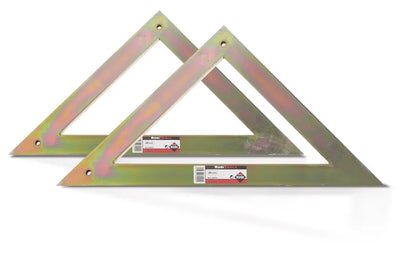
- Triangular squares for quick cutting and marking out of angles and slopes.
- Bricklayer's squares in high-strength steel.
- Adjustable squares for angles other than 90 degrees.
The brands included are Stanley, Metrica, Milwaukee, Pavan, Fervi, Probst and Rubi.
How to choose
Choose the length of the arms according to the pieces you need to square up, and the material according to the use: steel is sturdy, aluminium is light. A clear engraved scale and a well-machined stock make marking out more accurate.
For supplies of several squares or mixed assortments, request a quote from AMES.
Active filters:
Products in this collection
In your quote
In compare
 In your quote
In compare
 In your quote
In compare
 In your quote
In compare
 In your quote
In compare
 In your quote
In compare
 In your quote
In compare
 In your quote
In compare
 In your quote
In compare
 In your quote
In compare
 In your quote
In compare
 In your quote
In compare
 In your quote
In compare
 In your quote
In compare
 In your quote
In compare
 In your quote
In compare
 In your quote
In compare
 In your quote
In compare
 In your quote
In compare
 In your quote
In compare
 In your quote
In compare
 In your quote
In compare
 In your quote
In compare
 In your quote
In compare
Frequently asked questions: Squares
Which square should I choose: steel, aluminium or stainless steel?
Steel is sturdy and suited to the workshop and to metalwork. Aluminium is lighter and easier to carry on site, while stainless steel resists damp and corrosion better. In the catalogue you will find aluminium squares, such as the SRA, SRC and item 270, and stainless steel ones, such as the SRB. Choose according to the working environment and the weight you can carry.
How do I check that a square is truly at 90 degrees?
To check a right angle, rest the square against a straight edge and draw a line along the blade. Then turn it over by 180 degrees, rest it again and repeat the marking: if the two lines coincide, the square is accurate. Do not trust a square with play between the stock and the blade. Check several times before cutting or fixing the piece.
Which try square should I use for marking out on wood or panels?
The try square has a stock that rests against the edge of the piece, so marking stays accurate even on panels and timber. In the catalogue you will find SWA try squares and SRH wooden-base squares. The stock must stay firmly against the edge, while the blade must stay straight. Use it to mark the cut and to check squareness before fixing.
Which squares do tilers and bricklayers need for squaring and marking out?
The tiler's square is used to mark angles and to check the laying of tiles. Adjustable squares and sliding bevels, in wood, steel or the VSTG model, take any angle and copy it onto other pieces. The bricklayer uses the steel square to check the squareness of masonry and the plumb of walls.
What is an adjustable sliding bevel and what is it used for?
The adjustable sliding bevel has two articulated arms that lock at the desired angle with a screw. It is used to take an existing angle, for example of a roof or a joint, and transfer it onto the piece to be cut. In the catalogue you will find models in wood, in steel and in the VSTG version. Choose the model according to the length of the arms and the material to be worked.
How do I use a multifunction square or one with a protractor for angled cuts?
Multifunction squares combine several functions in a single instrument, and some have a protractor to read angles other than 90 degrees. The protractor is used for angled cuts and slopes. Rest the instrument against the edge and line the blade up with the reference, then check the graduation before cutting.
Which flexible squares or flange squares should I choose for pipework?
The flange square is used to check the alignment of the flange in relation to the pipe. Flexible squares, such as the Gortz item 1065 or the ZWC, bend to follow curved surfaces or non-straight profiles. For pipes and installations choose the square according to the diameter and the material, and check the result against a reference.