
 In your quote
In compare
Concrete Screws (Screw Anchors)
140 products · Heavy-Duty Anchors
Concrete screws, also known as screw anchors, are driven directly into concrete or solid masonry in a hole prepared with a drill bit, without the need for a wall plug: the special thread cuts into the substrate and creates the hold. They are used to fix profiles, frames, brackets, supports and light steelwork quickly and removably.
Types in the collection
- Screws with hex head, with or without flange.
- Screws with countersunk head or pan head, when the head must sit flush or remain visible.
- Galvanised and stainless steel versions for the dampest environments.
- Screws for lightweight concrete.
Brands in the collection: Fischer, SPIT, DeWalt, Bossong and Unifix.
How to choose
Start from the substrate (concrete, solid masonry, lightweight concrete), then choose the diameter and length according to the thickness to be fixed and the anchoring depth required by the manufacturer. The head shape depends on the element to be fastened, the material on the environment: stainless steel outdoors or where there is damp.
AMES Srl works on a quotation basis: write to us with the size and quantity and we will tell you availability and lead times.
Active filters:
Products in this collection
In your quote
In compare
 In your quote
In compare
 In your quote
In compare
 In your quote
In compare
DeWalt
Screw-in plugs, countersunk head, 70mm, Torx 25, chrome, pack of 100, DeWalt DFM4230070
Code DFM4230070
 In your quote
In compare
 In your quote
In compare
 In your quote
In compare
 In your quote
In compare
DeWalt
Screw-in plugs, countersunk head, 50mm, Torx 25, chrome, pack of 100, DeWalt DFM4230025
Code DFM4230025
 In your quote
In compare
 In your quote
In compare
DeWalt
Screw anchors Wall Dog round head 70 mm Torx 25 chrome-plated 100 pcs DeWalt DFM4260070
Code DFM4260070
 In your quote
In compare
 In your quote
In compare
 In your quote
In compare
 In your quote
In compare
 In your quote
In compare
 In your quote
In compare
 In your quote
In compare
 In your quote
In compare
 In your quote
In compare
 In your quote
In compare
Fischer
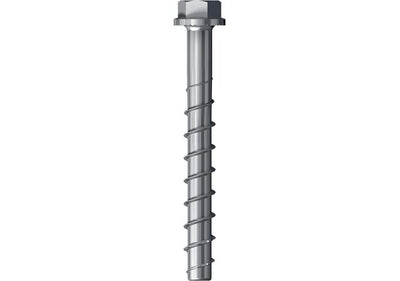
Concrete screw UltraCut FBS II 6 galvanised steel Fischer
Code fischer-ultracut-fbs-ii-6-in-acciaio-zincato
 In your quote
In compare
 In your quote
In compare
Fischer
Concrete screw UltraCut FBS II 8-14 US galvanised steel hexagonal head Fischer
Code 4048962251340
 In your quote
In compare
 In your quote
In compare
Frequently asked questions: Concrete Screws (Screw Anchors)
What are concrete screws and what are they used for?
They are screws that are driven directly into concrete or solid masonry, without the need for a plug. The special thread cuts into the substrate and creates a grip, so the fixing is quick and can be removed if needed. They are suitable for fixing profiles, brackets, frames and light supports, not for heavy structural loads without verification.
How do I drill concrete before inserting a concrete screw?
Use a hammer drill with a bit of the size indicated in the screw's product sheet, and drill the hole perpendicular to the surface. The depth must be the one indicated by the manufacturer, and the hole must be cleaned of dust before insertion. A hole that is too large or too small reduces the grip and can let the screw pull out.
Which head should I choose: hex, countersunk or round?
The hex head allows tightening with a spanner or screwdriver and is used when a strong grip is needed, including with a flange. The countersunk head is used when the fixing must sit flush with the surface, to avoid protrusions. The round head is chosen when the screw stays visible and appearance or protection against impacts matters.
Zinc-plated or stainless steel screws for concrete?
Zinc-plated screws are suitable for indoor and dry environments, while for humid, outdoor or seaside environments stainless steel screws are needed. Zinc protects from rust but wears away more quickly in the presence of prolonged humidity. Choose the material based on the environment and on the service life you need from the fixing.
Can concrete screws replace plugs?
For some light loads and removable fixings, concrete screws are a valid alternative to a plug, because they avoid enlarging the hole and are quicker to fit. For heavy, suspended or safety loads the choice must be made after a technical assessment and according to the manufacturer's sheet. Do not use a screw in place of an anchor without having verified its load capacity.
Which screws are suitable for aerated or lightweight concrete?
Aerated concrete is softer and less dense than normal concrete, so screws designed for that substrate are needed. Screws for lightweight concrete have a thread and length different from those for solid concrete. Check on the product sheet that the screw is indicated for the type of substrate before drilling.
Why does a concrete screw not hold if the hole is too large?
If the hole is wider than the indicated size, the thread no longer grips the substrate and the screw spins without tightening. In this case the grip is poor and the fixing can give way under load. If the hole is wrong, do not fill it with improvised materials: drill a new hole in the right position, at an adequate distance from the edge.
How do I remove a concrete screw without damaging the substrate?
Unscrew the screw with a screwdriver or driver, turning anticlockwise with a steady movement, without forcing it. If the head is damaged, use a spanner or pliers suitable for gripping the screw. The hole that remains can be reused with a screw of the right size, or filled with a compatible material.