
 In your quote
In compare
SpanSet
168 products
SpanSet is a brand specialising in devices for safety when working at height and for lifting and handling loads. This collection brings together its products available from AMES, chosen for those who work at height, lift materials or carry heavy loads every day.
Types of product in the collection
- Harnesses: harnesses for work at height and for use on aerial work platforms.
- Lifting slings and straps: recovery straps and round slings for lifting and rigging loads.
- Exoskeletons: such as CarrySuit, a wearable support that reduces effort when carrying loads.
How to choose
For work at height, the type of activity and the anchor point matter; for slings, the rated capacity and a length suited to the load. Every device has a maximum working load that must not be exceeded: use only products suited to the weight and the task.
For quantities, availability and delivery times, AMES Srl works by quotation: write to info@amessrl.com or call 051 728529.
Active filters:
Products in this collection
In your quote
In compare
 In your quote
In compare
 In your quote
In compare
 In your quote
In compare
 In your quote
In compare
 In your quote
In compare
 In your quote
In compare
 In your quote
In compare
 In your quote
In compare
 In your quote
In compare
 In your quote
In compare
 In your quote
In compare
 In your quote
In compare
 In your quote
In compare
 In your quote
In compare
 In your quote
In compare
 In your quote
In compare
 In your quote
In compare
 In your quote
In compare
 In your quote
In compare
 In your quote
In compare
 In your quote
In compare
 In your quote
In compare
 In your quote
In compare
Frequently asked questions: SpanSet
What are SpanSet fall-arrest harnesses used for?
SpanSet harnesses hold the person working at height so that, in the event of a fall, they stay suspended and do not hit the ground or a structure. They are connected with a lanyard or an anchor device to a fixed point or to a lifeline. For fall-arrest harnesses the reference is the EN 361 standard. The connection system changes depending on the job, for example on a mobile elevating work platform or on a roof.
What is the difference between SpanSet lifting slings and round slings?
Lifting slings are flat and made of polyester, and are used to sling loads with delicate surfaces or sharp edges. Round slings are endless loops that wrap around the load or a hook. For lifting slings the reference is the EN 1492-1 standard, for round slings EN 1492-2. In both cases the rated capacity on the label changes with the angle of the legs: the wider they are spread, the less load they can carry.
Which SpanSet swivel eye bolt should I choose for lifting a load?
SpanSet swivel eye bolts are available with ball bearings, with a bow or with a ring, and are chosen according to the working load limit marked on the body. The direction of pull must also be considered, because an eye bolt loaded sideways has a lower capacity. Before using it, check that the thread is complete and that the eye bolt rotates freely without excessive play.
How do you use SpanSet Exoset G100 ratchet tensioners to secure a load?
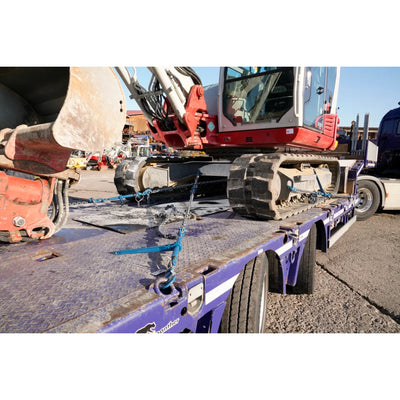
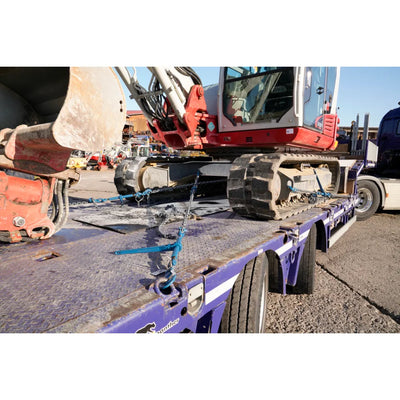
Exoset G100 ratchet tensioners are used to tension a lashing strap or an anchoring chain over a load, in order to secure it on a transport vehicle. Each end is hooked onto the designated points, the lever is used to tension up to the correct tension and the ratchet is locked. Choose the tensioner with the right capacity for the load and inspect the hooking system before setting off.
Which VarioWeb MultiSet adjustable sling should I choose: 1, 2 or 4 legs?
VarioWeb MultiSet slings are chosen according to the number of legs, that is, the attachment points that connect the load. With one leg the sling is a simple one and is used for a single lifting point. With two or four legs the load is spread over several points, which is useful for long or unstable pieces. Check the rated capacity shown for the number of legs used, because it changes with the angle and with the number of legs under tension.
Which SpanSet lashing straps and tie-down webbing should I use to secure a load on a lorry?
To secure a load on a lorry or trailer, lashing straps and tie-down webbing are used, such as the TruckFix strap or the WRAPPA webbing. They are chosen according to width, the lashing force in daN shown and the type of load. For lashing webbing the reference is the EN 12195-2 standard. The webbing must be checked before use: no cuts, fraying or wear on the edges.
Where are SpanSet suspension trauma straps and Spectre lanyards used?
Suspension trauma straps and Spectre lanyards are designed for people who work suspended on a rope, for example when inspecting or maintaining structures at height. Their purpose is to reduce the risk linked to suspension trauma, that is, the physical distress that can appear after a fall arrested by the harness. The lanyard must only be connected to suitable anchor points, with a length that limits the free fall.